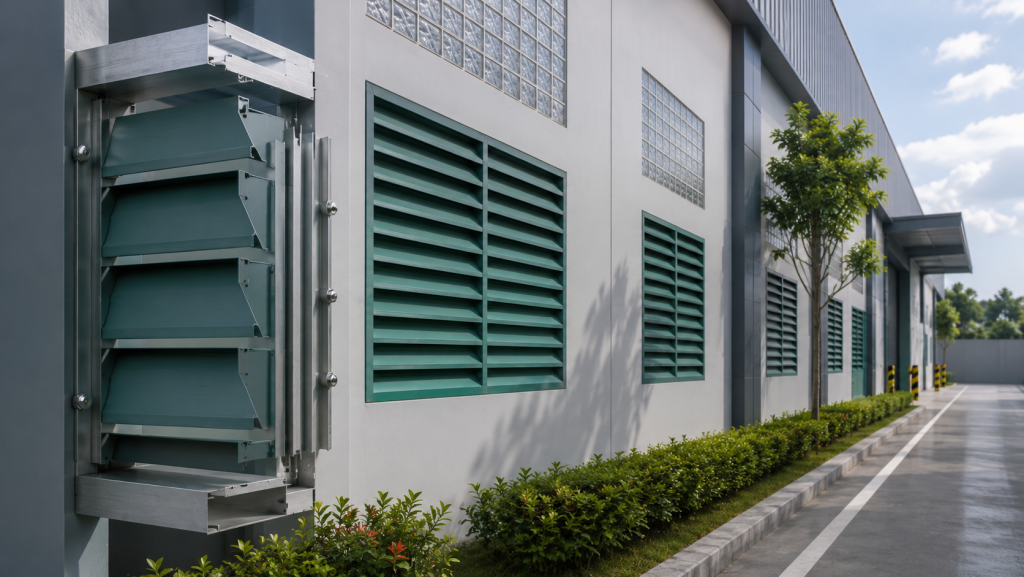
In commercial and industrial buildings, the facade has a bigger role than just the outer appearance. It can affect comfort, airflow, natural lighting, heat exposure, and the overall impression of the building.
That is why facade elements should not be chosen only because they look good. The material also needs to be strong, weather-resistant, flexible for design needs, and able to support the function of the building. One element that is widely used for this purpose is a metal louver.
A metal louver is a set of metal slats or blades installed on facades, ventilation areas, or specific parts of a building. The blades can be arranged horizontally or vertically, depending on the design and functional requirements of the project.
In commercial buildings such as offices, showrooms, shops, and service centers, as well as industrial buildings such as factories and warehouses, metal louvers are often chosen because they offer several functions at once. They can improve the building appearance, support airflow, and help cover technical areas in a cleaner way.
1. Creates a More Modern Facade Appearance
One of the main reasons metal louvers are used in commercial and industrial buildings is their appearance. The clean arrangement of blades can make the facade look more organized, modern, and professional.
For commercial buildings, the exterior plays an important role because it creates the first impression. Offices, showrooms, service centers, and business buildings usually need a facade that looks neat and credible. Metal louvers can help create that impression without adding too many decorative elements.
For industrial buildings, facades are often designed to be simpler and more functional. But that does not mean the building has to look plain or unfinished. With metal louvers, factories and warehouses can still look cleaner and more well-planned from the outside.
2. Supports Better Air Circulation
Besides being a visual element, metal louvers also support air circulation. The blades are arranged with certain spacing and angles, allowing air to move in and out of the building area.
This function is useful for industrial buildings that have production areas, storage rooms, utility spaces, or mechanical zones. These areas usually need proper airflow so the space does not become too hot or stuffy.
Metal louvers allow ventilation to continue without leaving the area fully exposed. The building can still get airflow, while the exterior remains covered and visually organized.
3. Helps Reduce Direct Sunlight
On certain sides of a building, direct sunlight can be quite strong. This can increase heat inside the building, especially when the facade faces the sun for long hours.
Metal louvers can help reduce this exposure. The louver blades work as a filter that blocks part of the direct sunlight without making the area completely dark.
For commercial buildings, this can help improve indoor comfort. For industrial buildings, reducing heat from the outside can also help create a more comfortable working environment, especially in areas that need additional ventilation.
4. Suitable for Covering Technical Areas
Modern buildings often have many technical areas that are needed for operation but do not always need to be fully visible. These may include mechanical rooms, utility spaces, ventilation paths, rooftop equipment, or other service areas.
Metal louvers are often used to cover these areas. From the outside, the technical parts of the building look cleaner. At the same time, air can still move through because louvers do not fully close the surface.
This function is useful for both commercial and industrial buildings. The building can maintain a tidy appearance while the technical needs still work properly.
5. Stronger for Outdoor Use
Building facades are constantly exposed to heat, rain, wind, dust, and changing weather conditions. Because of this, the material used on the exterior needs to have good durability.
Metal louvers are more suitable for this kind of condition compared to materials that may easily deform or deteriorate when exposed to weather. With the right material and finishing, louvers can be used for long-term exterior applications.
This durability is important for commercial and industrial projects, where the material is expected to last longer and require more efficient maintenance.
6. Flexible for Different Design Needs
Every building has different design needs. Some buildings need a minimalist look, some need a more industrial character, and others need a facade with a stronger visual identity.
Metal louvers are flexible enough to support these needs. The installation direction, blade spacing, size, form, and color can be adjusted to match the building concept.
On commercial facades, louvers can become a visual element that strengthens the building identity. In industrial buildings, louvers can be focused more on functional needs such as ventilation, technical area covering, or side facade treatment.
7. Can Be Customized Based on Project Conditions
Not every project can use a standard-sized product. Some site conditions require adjustments in size, shape, installation position, or finishing.
Metal louvers have an advantage because they can be made more flexible based on project needs. This is helpful for buildings with special designs or installation areas that are not typical.
With the right specification, louvers can be installed as part of the facade system, ventilation element, or covering for certain areas without disturbing the overall building design.
8. Makes the Building Look More Well-Planned
A well-designed commercial or industrial building can often be seen from its facade details. Elements like louvers can make the building look more organized and intentional.
For example, utility areas that were previously exposed can be made cleaner with metal louvers. A plain building side can also gain visual rhythm through the repeated pattern of louver blades.
These details may look simple, but they can strongly affect the final impression of the building. The building appears more professional, more modern, and more suitable for business or operational use.
JSteel Metal Louvers for Commercial and Industrial Buildings
JSteel provides JSteel Louver products that can be used for facade and ventilation needs. These products are suitable for projects that require both technical function and a clean visual appearance.
With material options such as Galvanized and AluZinc/BJLAS, as well as finishing options like pre-painted or two-sided acrylic paint, JSteel Louvers can be adjusted to match the building design and project conditions.
Because the product is non-standard, the size and form can follow site requirements. This makes metal louvers more flexible for various projects, including commercial buildings, industrial buildings, and supporting facilities.
Conclusion
Metal louvers offer many benefits for commercial and industrial buildings. They can improve facade appearance, support airflow, reduce direct sunlight, cover technical areas, and make the building look cleaner and more organized.
Metal louvers are also suitable for outdoor use because they are strong and can be adjusted based on project needs. With the right material, size, installation direction, and finishing, louvers can become both a functional and aesthetic solution for buildings.
For facade and ventilation needs in commercial or industrial projects, JSteel Louver can be a flexible option that can be customized based on site conditions.